Student Info
Menu | See top-right corner of this window
- Education System
- Elementary school
- K-6 (QC)
- K-8 (Canada & USA)
- Secondary school = High School
- Diploma - DES = Grades 7-11 = Secondary 1-5 (QC) = diplôme des études secondaires
- Diploma - Grades 9-12 (Canada)
- College
- QC = CEGEP system = Collège d'enseignement général et professionnel
- Note that "professionnel" means "vocational" or "technical" and NOT "professional". AEC
- Note that "général" means "academic preparation for higher education (perhaps for a profession like teaching, law, medicine)". DEC
- AEC = Certificate = 3 years = Vocational (training to enter directly into the workforce) = Attestation d'études collégiales
- CEC = Certificate = 3 years? = Vocational (training to enter directly into the workforce) = Certificat en études collégiales
- DEC = Diploma = 2 years = General (preparation for university) = Diplôme d'études collégiales
- = DCS = Diploma of Collegial Studies = DEC
- QFB = Quebec French Baccalaureate
- Canada - (usually a community college)
- Certificate or Diploma - Vocational training to enter directly into the workforce
- Degree - Universities (see below) may have colleges within the university. You graduate from a university with a degree. Secondary schools do not award degrees.
- Some Canadian colleges now offer degree programs.
- USA
- Certificate or Diploma - Vocational (training to enter directly into a trade) - junior college
- Degree - In the USA, a college is often the same as a university. Universities are state run. Colleges are private. (Associate's = 2-year degree) - (Bachelor's = 4-year degree)
- University
- Degree
- Associate's degree - (AA, AS, AAS, etc.) - 2 years after high school = 2-year degree
- What is an Associate Degree? - "a two-year degree awarded by community colleges, career schools, colleges, and universities."
- WikiAnswers - What is an Associate's Degree AAS - (AA, AS, AAS) - "... for transfer purposes to a four year college or university - that they satisfy the four years institutions first two year general cluster area ... the AAS is designed to give an individual all the expertise necessary to enter their chosen career - at least at an entry level position."
- Associate degree = A two-year degree from a junior college or = not a real degree or = full degree not completed.
- In the USA and, uncommonly, in Canada , an associate degree is equivalent to the first two years of a four-year college or university degree. It is the lowest in the hierarchy of post-secondary academic degrees offered in these countries.
- Graduates of community and junior colleges ordinarily earn an associate`s degree. The degree most awarded is the associate in arts (A.A.).
- A US associate degree is a 2-year degree given by two types of colleges upon completion of an associate degree program. The three classes of US associate degrees offered are the associate of arts degree (also called the A.A. degree), the associate of applied science degree (also called the A.A.S. degree), and the associate of science degree (A.S. degree). US Community colleges offering associate degree programs are operated by the local government and are financed by public funds. US junior colleges offering associate degree programs are generally privately run. Both are excellent options for those wanting to earn an associate degree.
An associate degree is a college degree awarded after the completion of about 20 classes. It either prepares students for a career following graduation or allows them to transfer into a bachelor's degree program.
- DeVry University - Associate Degree - Electronics and Computer Technology Degree - (AS or AAS, not BS or BSc) = 2-year degree program
- Bachelor's degree - (BA, BEd, BS, etc.) = undergraduate degree - 4 years after high school or 2-3 years after college = 4-year degree
- In Quebec and Belgium, the term baccalauréat ("bac") is used in French for a bachelor's degree.
- Master's degree - (MA, MS, MBA, etc.) = graduate degree - 1-2 years after a Bachelor's degree
- Doctorate - (PhD, EdD, MD, etc.) = postgraduate degree - several (3-7) years after a Master's degree
- ABD = All But Dissertation = completed all courses but never completed the research project - After a given time, it becomes impossible to complete the degree. The degree is not conferred (awarded).
- Fraudulent Degree
-
Don't even think about buying a degree or falsifying your Résumé or CV (Curriculum Vitae). You will be caught. It is not legal or moral.
- GPA
- GPA = Grade Point Average = Grade Points / Credit Hours = Quality Points / Quality Hours
- Quality Points = Grade points = Honour Points = Point value (of the letter grade) * Credit hours
- Quality Hours = Credit hours = Course weight
- NMU Academic and Career Advising Center | GPA Calculator
- University of Memphis | Grading Scale and GPA - Registrar
- QualityPoints are a measure used by some universities and colleges to rate your success in a course.
- If you get 100% as a final grade, that gives you 4 quality points. If you get <= 60%, that gives you 0 points. 80% gives you 2 points, and so on. Quality points may be calculated as MAX( (Mark-60) / 10, 0 ).
- GPA: - A Grade Point Average or GPA is an average of your quality points for all courses.
- To find the GPA, you divide your Total Quality Points by the number of courses completed (called your Credits). For example, if you had done four courses and got 100% in all of them (WOW - you're good!) you'd have 16 points divided by 4 giving a GPA of 4.00.
- 100% = 4 points
- 90% = 3 points
- 80% = 2 points
- 70% = 1 points
- <=60% = 0 points
- CRC = La cote de rendement au collégial = la cote R
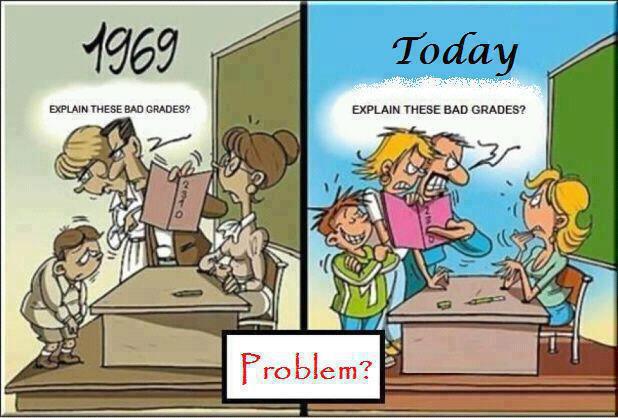 Failure or Success?
Why do students fail and drop out of school, especially in the CEGEP system in Quebec?
- Work. (Students work after/during school hours for fun-money/survival.)
- Programs. (Quality/selection of programs offered by the school.)
- Instruction. (Quality of instruction/instructors.)
- Course load. (The number of required courses per term and the hours spent in class and doing homework.)
- Distractions. (Games, movies, friends, parties, etc.)
- Attitude. Some students just don't care.
- Personal problems.
- Parents.
- ...
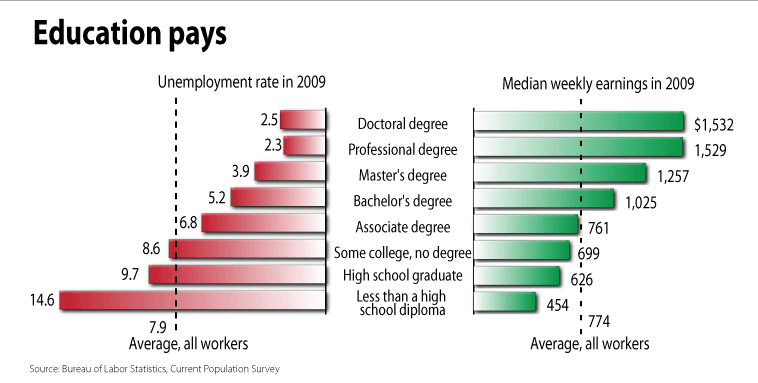 Education pays
 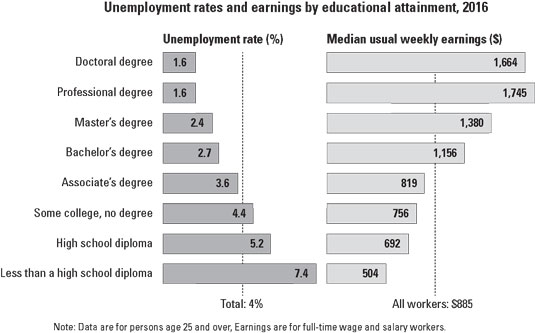 Unemployment rates